No Invitation Required: How Don Antonio's Open Door Turned LA Into a Collaboration Capital
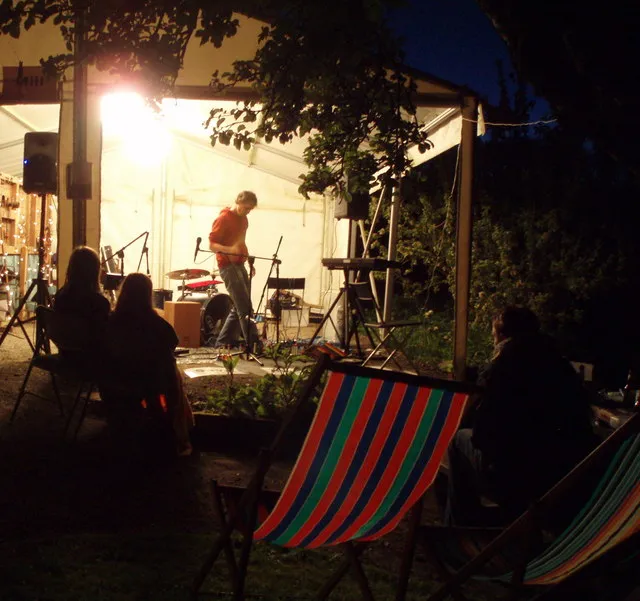
Photo: Gwen and James Anderson, CC BY-SA 2.0, via Wikimedia Commons
There was no email list. No cover charge. No guest list taped to the door. If you showed up at Don Antonio's place on the right night, you might find a jazz pianist trading chord progressions with a Chicano rock guitarist in the kitchen, a playwright scribbling notes in the corner while two backup singers ran harmonies over a beat someone had pulled out of their back pocket. Nobody announced these gatherings. They just happened — and then they kept happening, for years, until they became something bigger than any single room could hold.
Those informal sessions, which regulars came to call the Cipher — borrowing the hip-hop term for an open, rotating creative circle — weren't a program or a policy. They were a personality trait. Don Antonio genuinely believed that the best artistic ideas didn't live inside any one person's head. They lived in the friction between people who had no business being in the same room together.
A Room That Refused to Stay Quiet
The way longtime collaborators tell it, Don Antonio's space had a gravitational pull that was hard to explain and impossible to ignore. Whether it was a rehearsal studio, a back room at one of his venues, or his own home, the place always seemed to be mid-conversation. Someone was always working something out.
What made it different from the usual industry hangout wasn't just the access — it was the atmosphere. Don Antonio had a gift for making people feel like whatever they were working on mattered, even in its roughest, most unfinished form. He'd pull up a chair next to a musician who was stuck on a bridge and ask one question — usually the exact right question — and suddenly the whole thing opened up. He wasn't trying to produce the session. He was trying to keep the energy honest.
That low-pressure environment turned out to be exactly what a lot of LA artists needed. The city had always been full of talent, but talent and connection don't automatically find each other. Don Antonio's open-door policy was essentially a standing invitation to close that gap.
Where the Unexpected Partnerships Were Born
Some of the most talked-about creative pairings to come out of Don Antonio's world didn't start with a pitch meeting or a record label introduction. They started with someone wandering into one of those late-night sessions and hearing something that stopped them cold.
There's the story — told with variations depending on who's doing the telling — of a theater director who came by to drop off some sheet music and ended up staying until 3 a.m., sketching out what would eventually become a full-scale musical production with a composer she'd never met before that night. Or the rapper and the mariachi bandleader who kept running into each other at Don Antonio's for months before they finally sat down and made something together, a track that went on to get heavy rotation on local radio and opened doors neither of them had been knocking on before.
These weren't flukes. They were the logical result of consistently putting creative people in the same space without an agenda and trusting that something would catch.
The Philosophy Behind the Practice
Don Antonio talked about collaboration the way some people talk about cooking — you need good ingredients, the right heat, and the patience to let things develop. He wasn't interested in forcing creative relationships. He was interested in creating conditions where they could emerge naturally.
That philosophy ran counter to a lot of how the entertainment industry in LA operated. The industry ran on gatekeepers. Don Antonio ran on open doors. He had a particular skepticism toward the idea that creativity needed to be managed or curated from the top down. In his view, the most interesting things happened when you got out of the way.
He also had a deep appreciation for cross-disciplinary thinking long before that phrase showed up in every artist residency brochure. Bringing a visual artist into a music session, or a dancer into a screenwriting conversation, wasn't a gimmick for him. It was a genuine belief that different art forms could solve each other's problems in ways that staying inside one lane never could.
What Got Built in Those Rooms
The tangible output from Don Antonio's Cipher sessions is hard to fully catalog because so much of it fed into larger projects without clear attribution. But the people who were in those rooms are pretty consistent about what they took away.
For a lot of artists, it was their first real experience of creative risk-taking without consequences. There was no audience to impress, no label exec in the corner taking notes. You could try something weird and have it fall apart and nobody cared, because someone else was already trying something weirder. That kind of low-stakes experimentation is genuinely rare in a city where everyone is perpetually auditioning for something.
For others, it was simply about finding their people. LA is enormous and famously hard to navigate as a creative. The Cipher sessions functioned as a kind of self-organizing community — artists who kept showing up eventually became a network, and that network became a support system, and that support system became a launching pad.
The Attempt to Recreate the Magic
In the years since Don Antonio's most active era, plenty of people have tried to bottle what he built. You can see the echoes in the various artist collectives, creative co-ops, and open-session events that have popped up across LA — from Echo Park to Leimert Park to the Arts District. Some of them are genuinely great. Some of them feel like they're working a little too hard to seem spontaneous.
The artists who knew Don Antonio personally tend to say the same thing when asked what made his version work: it wasn't the format, it was the person. The open door meant something because of who was holding it open. Don Antonio brought a specific combination of genuine curiosity, zero ego, and deep institutional knowledge of LA's creative landscape that made people want to be in his orbit and want to give their best once they got there.
That's not something you can replicate with a Meetup event and a bowl of chips. But it's also not entirely out of reach. The artists who carry Don Antonio's influence most visibly tend to be the ones who've internalized that same spirit — the ones who make room for other people's ideas, who ask good questions, who stay curious about what happens when different worlds collide.
The City Still Has the Habit
Los Angeles is still, fundamentally, a city where the best things happen in rooms nobody planned for. The industry has changed, the venues have changed, the technology has changed. But the impulse to gather, to play something unfinished in front of a trusted audience, to see what sparks when the right people end up in the same space — that hasn't gone anywhere.
Don Antonio didn't invent that impulse. But he gave it a home, and he kept the lights on long enough for it to become a habit. That habit is still running through the city's creative DNA, showing up in every late-night session, every impromptu collab, every moment when someone leaves a door open and sees who walks in.